
Masorah
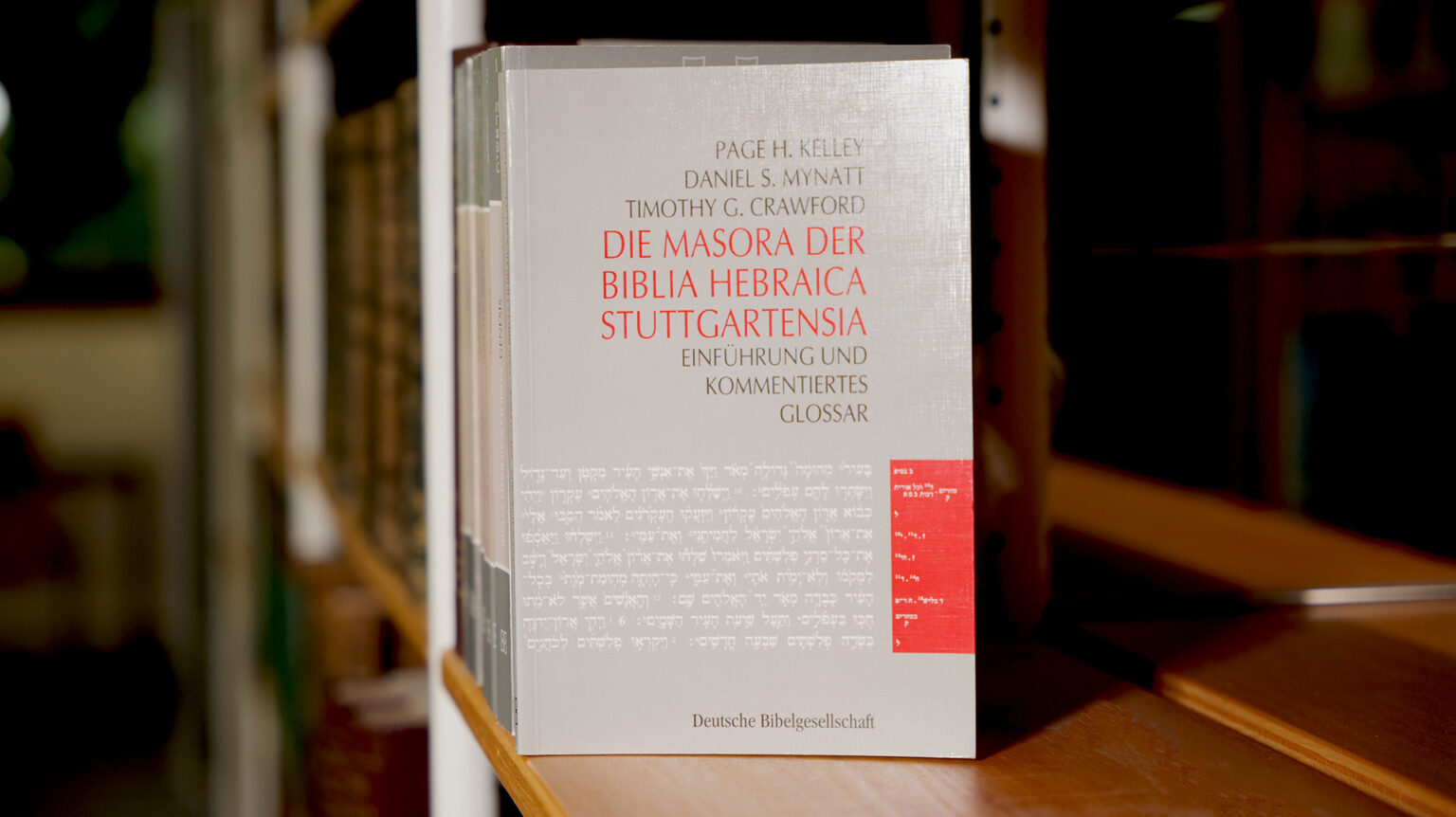
“Masorah” and “Masoretic text”
A distinctive feature of written Hebrew is that it omits most vowels. For more than a thousand years, only the consonants were written, while readers had to supply the appropriate vowels from memory when pronouncing the text. This characteristic also applies to the Qumran manuscripts.
This "consonantal” text of the Hebrew Bible has been regarded as fixed (= not to be changed) since the first century CE, and Jewish tradition has ever since attached great importance to its precise transmission. However, the problem arises that the consonantal text frequently allows for different possible pronunciations and thus potentially also different meanings. Knowledge of the correct pronunciation and meaning therefore had to be passed down from generation to generation together with the written text. Around 600 CE, Jewish scholars, the so-called Masoretes (literally “conveyors of tradition”) developed a system of vowel and emphasis marks that also precisely fixed or established the pronunciation and thus the meaning of the Hebrew Bible text.
At the same time, the Masoretes conducted textual research of remarkable quality. In addition to fixing pronunciation and meaning, they sought to safeguard the biblical text against copying errors and, where possible, to correct existing ones. To this end, they added extensive marginal notes to their manuscripts, recording orthographic variants, statistical data on word usage, and even indications of where they believed an alternative reading might be preferable to the received consonantal text. This collection of marginal notes is known as the Masorah parva (“Small Masorah”).
Alongside these notes, the Masoretes also compiled lists of entire passages of the biblical text characterized by distinctive spelling variants, unusual word sequences, or other textual features. These lists, collectively known as the Masorah magna (“Large Masorah”), were written at the top and bottom of the manuscript pages.
The meticulous work of the Masoretes gave rise to what is now called the Masoretic Text—the carefully transmitted version of the Hebrew Bible that became authoritative. Owing to their precision and dedication between the sixth and eighth centuries, the Hebrew Bible has since been preserved in a remarkably uniform form, with only minor textual variations.
